

[tp not_in=”es”]
Said Dokins has developed a body of work focused on creating a new visual understanding of the environment by focusing on textual elements as well as the tensions between the social fabric of the city, cryptography, and architecture.
For International Public Art Installation Festival Querétaro Experimental, the artist has built a quadrangular prism that is over five meters high, which is based on a series of physics experiments with transparent and reflective materials—such as tempered glass, stencils and LED light—from which he plays with shapes while deconstructing the linguistic sign through calligraphy
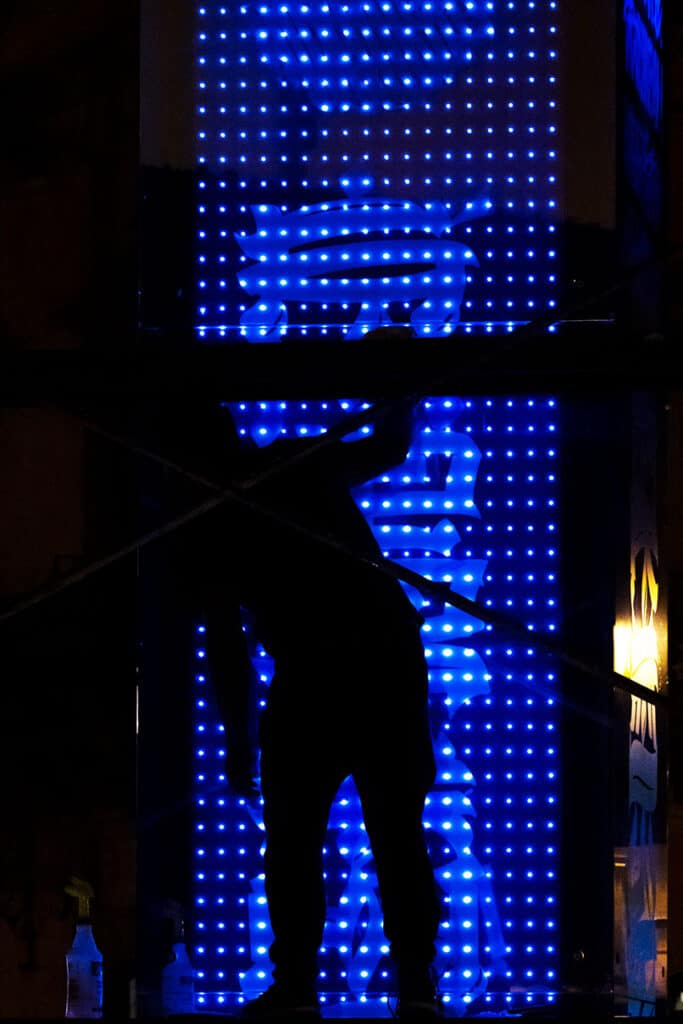
As if it were a strange body of sibylline writings stuck to the landscape, Refraktur installation is located in front of the Neptune fountain, where it draws energy from the crowds of people who pass through the Madero boulevard.
The artist physically unsettles the historical setting through subtle and contrasting gestures, examining the way the light changes between day and night, playing with material and scale, as well as the reflection of passers-by. He is inviting the viewer to question their surroundings and the threshold between the word and the image, the relevance of the objects that appear around them and the role they themselves play within that space.
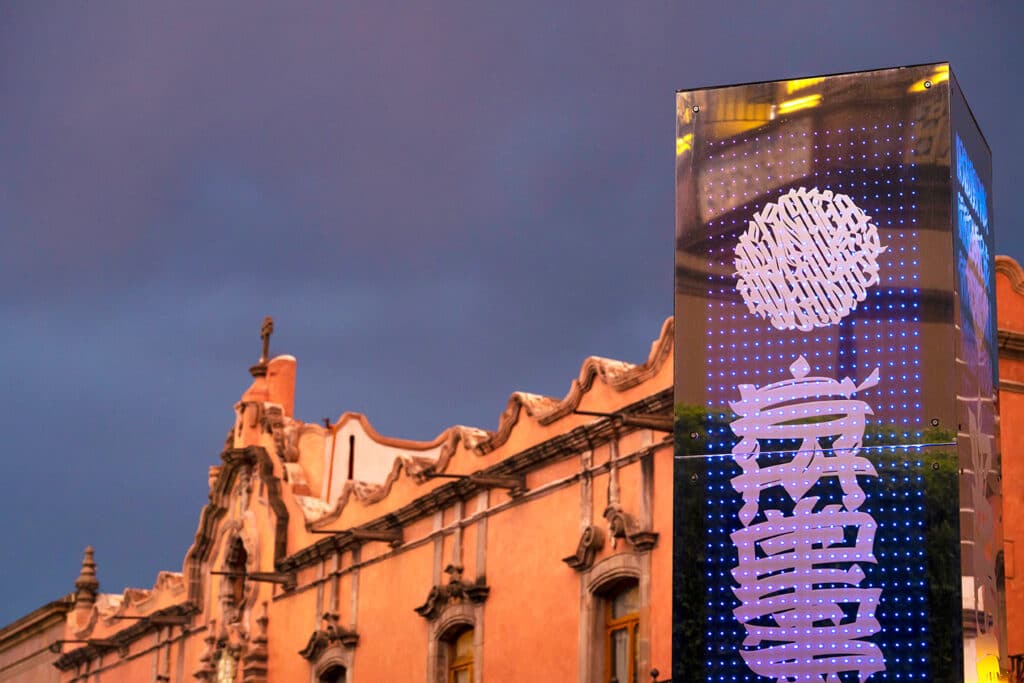
“This installation seeks to create an atmosphere that invites the public to reflect on its presence and the environment, through a scriptural space in the form of a tower that during the day appears as a mirror and during the night is illuminated through the screen hidden within the structure, where a series of words, signs and symbols are in constant movement,” explains Dokins.
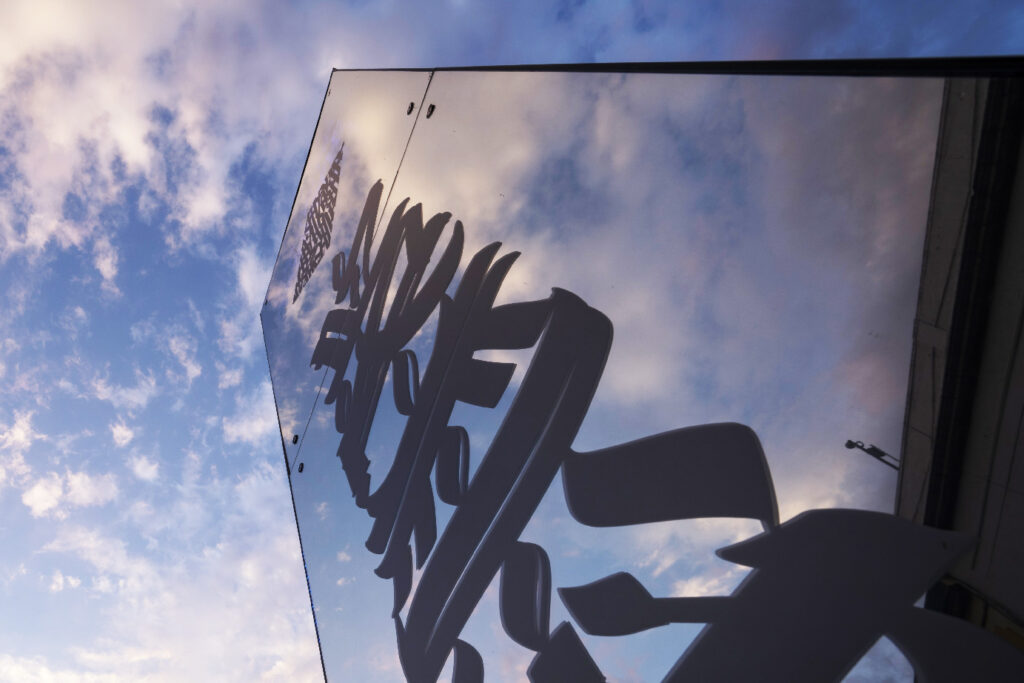
The visibility and concealment of letters and objects is part of Said Dokins’ research on inscription and memory, which he relates to the notion of phantasmagoria
“It is just the idea of cracking, fracturing, and refraction that share the interaction of light with transparent objects, as in the phantasmagoria of the late eighteenth century, a series of optical illusions of light and shadow that were used as a horror show.
Here, the mirror is used to hide the words during the day, which appear later, at night, as a kind of scriptural ghost through the light stencil at night. It is also related to scriptural practices, especially in medieval writing, of which many examples still exist today. If we think in terms of the present day then perhaps phantasmagoria would appear as that hidden aspect of the illusion of progress, as a mark or wound from the past,” says Dokins.
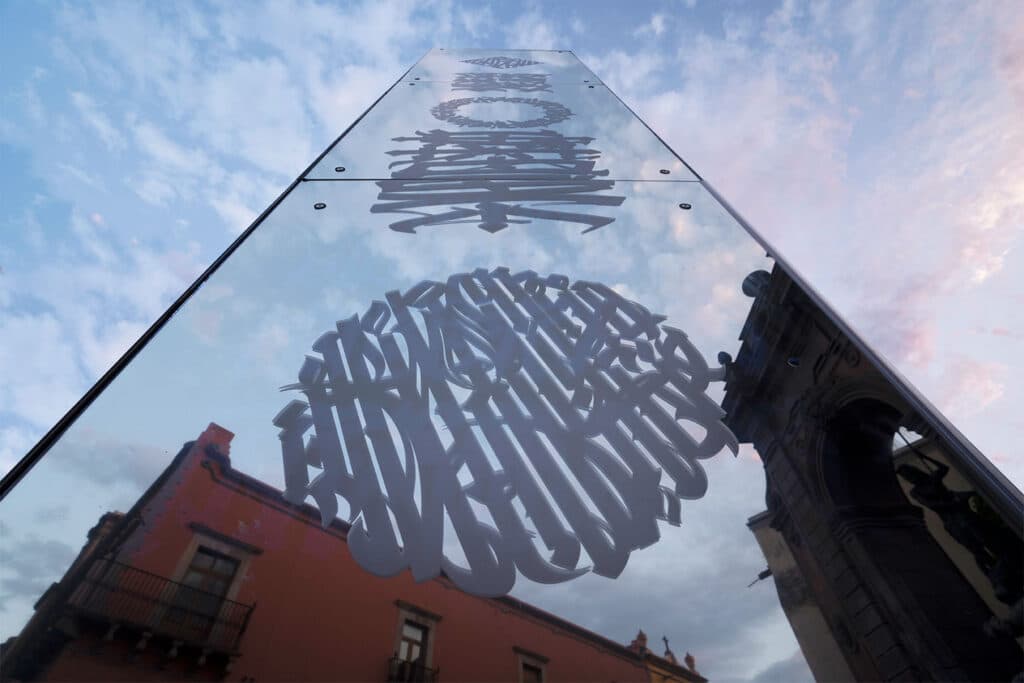

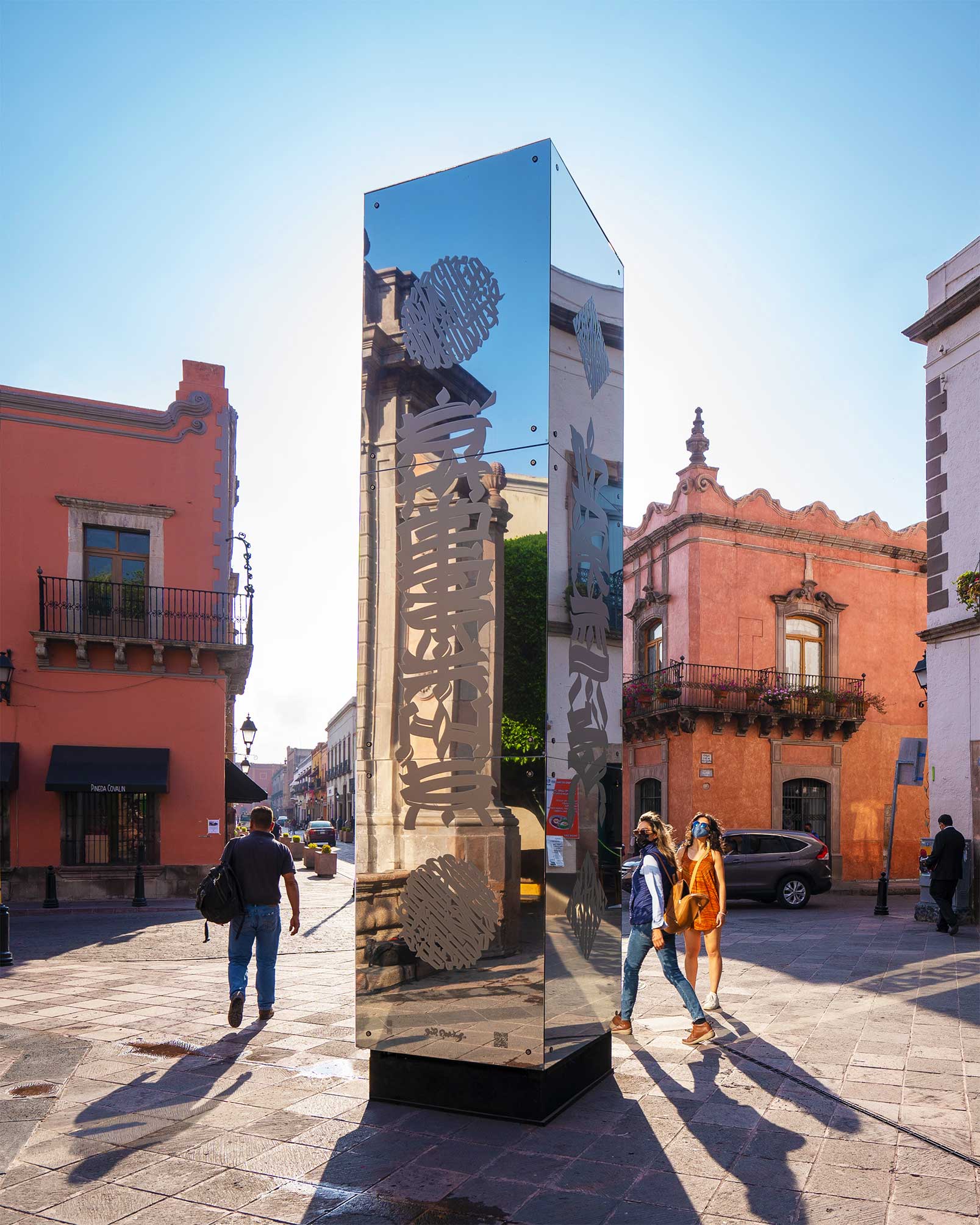
The formal aspect of Dokins’s installation becomes accessible by transferring it to a minimalist vocabulary such as the prism, which simultaneously hides a series of textures, symbols and signs where the interpretation depends on each viewer’s subjective references.
The various ways in which visitors interact within the context of the installation also intervene in the reading process—previous references are remodeled to reveal revealing a constant tension between the established and the newly unfolding, identity and belonging; between the legible and the encrypted, the inscription and the erasure.
CREDITS
Refraktur
Author: Said Dokins
Team:
Architecture: Jesús López, assistant: Adrián Campos
Engineering: Abdey Octavio Méndez García
Industrial design and manufacture of metallic structure:
Luis Enrique Aguilar Macias
Pailería: Carlos Rubio Meza and Víctor Mendoza
Cancelería: Ricardo Ortega Valdemar
Lighting: Leonel Alvarez
Programming: Karla León
Animation: Roberto Palma
Photography: Leonardo Luna
[/tp][tp not_in=”en”]
Refraktur es una instalación temporal en sitio específico construida con cristal, metal, materiales reflejantes y luces led emplazada sobre el andador Madero en el centro de la Ciudad de Querétaro en México. Esta obra forma parte del continuo trabajo de intervenciones efímeras que el artista ha realizado en espacios públicos alrededor del mundo.
Said Dokins ha desarrollado un cuerpo de trabajo enfocado en crear una nueva comprensión visual del entorno centrándose en elementos textuales, así como en las tensiones entre el tejido social de la ciudad, la criptografía y la arquitectura.
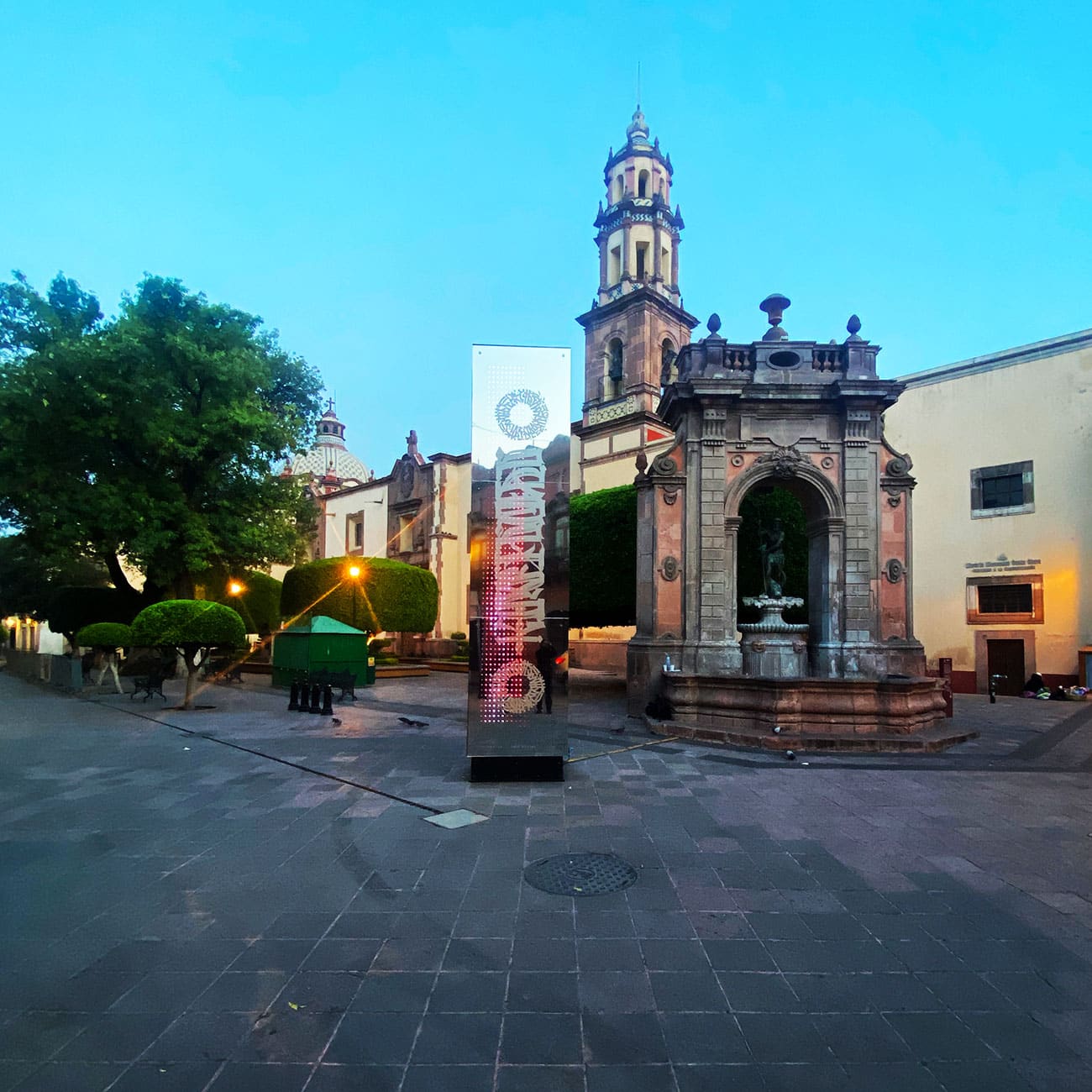
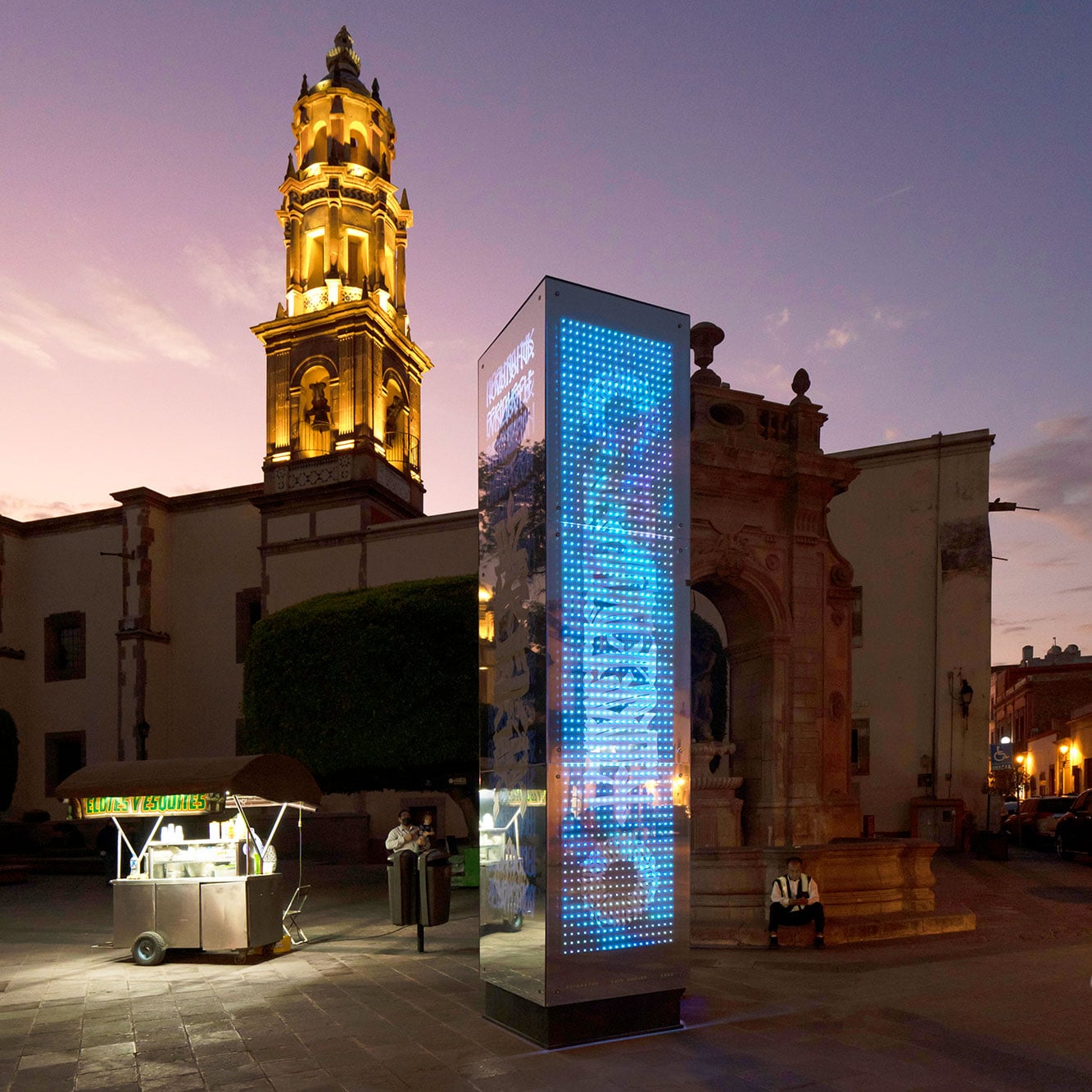
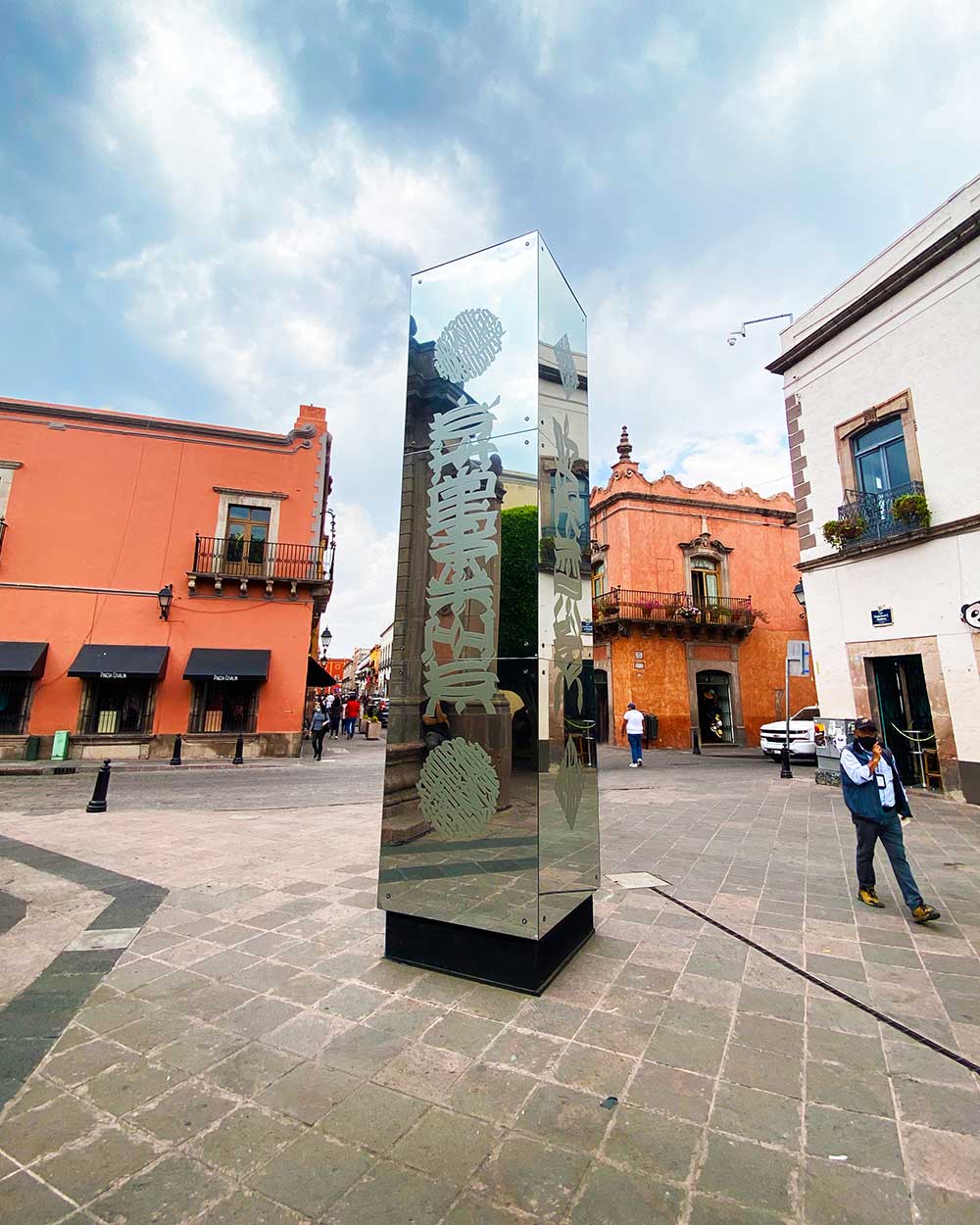
Para Querétaro Experimental, el artista ha construido un prisma cuadrangular de más de cinco metros de altura, a partir de una serie de experimentos físicos con materiales transparentes y reflectantes como el cristal templado, el esténcil y la luz led, a partir de los cuales juega con las formas al tiempo que deconstruye el signo lingüístico a través de la caligrafía.
Como si tratase de un cuerpo extraño de escrituras sibilinas adherido al paisaje, Refraktur se ubica frente a la fuente de Neptuno, desde donde extrae energía de los cientos de personas que transitan por el Andador Madero. Por medio de gestos sutiles y contrastantes, cambios lumínicos durante el día y la noche, el juego con el material y la escala, así como el reflejo de los transeúntes, el artista perturba el sitio histórico mientras invita a los espectadores a cuestionar su entorno y el umbral entre la palabra y la imagen, la pertinencia de los objetos que aparecen a su alrededor y el papel que juegan ellos mismos dentro de ese espacio.
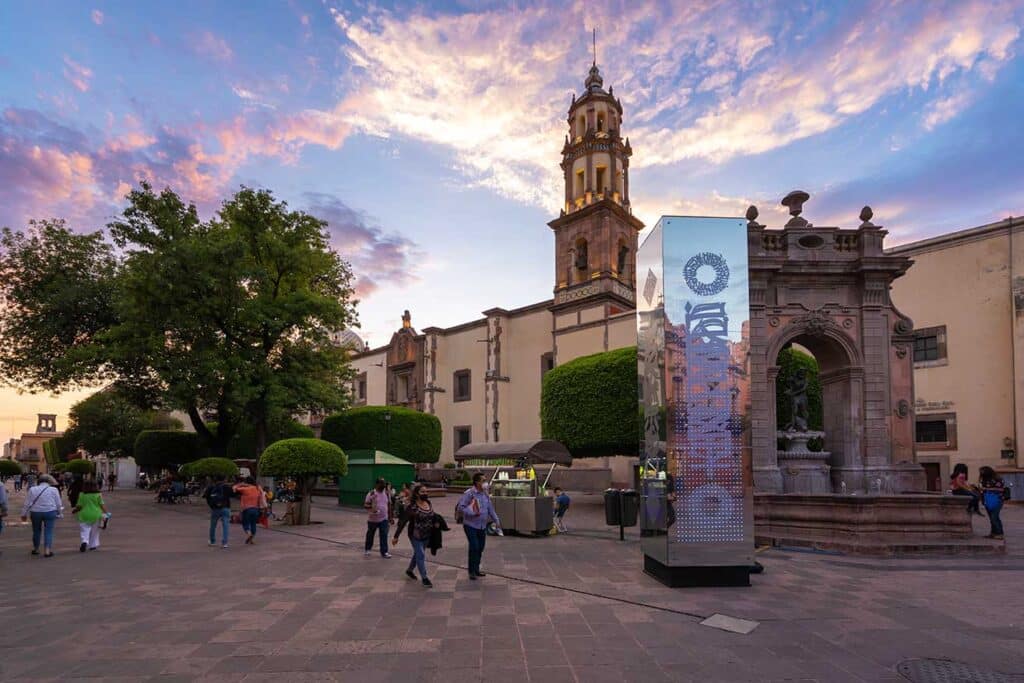
‘Esta pieza busca crear una atmósfera que invite al público a reflexionar sobre su presencia y el entorno, mediante un espacio escritural en forma de torre que durante el día aparece como un espejo y durante la noche se ilumina a través de la pantalla escondida dentro de la estructura, donde una serie de palabras signos y símbolos están en constante movimiento’, explica Dokins.
La visibilidad y el ocultamiento de letras y objetos es parte de la investigación de Said Dokins sobre la inscripción y la memoria, la cual relaciona con la noción de fantasmagoría:
‘Es justo esta idea de resquebrajamiento, fractura y refracción que comparten la interacción de la luz con objetos transparentes, como en la ‘fantasmagoría’ de finales del siglo XVIII, una serie de ilusiones ópticas de luces y sombras que se usaban como espectáculo de horror.
Aquí utilizo el espejo para ocultar las palabras durante el día, que después aparecerán como una especie de fantasma escritural mediante el esténcil de luz por la noche. También se relaciona con las prácticas escriturales, sobre todo la escritura medieval de la que se pueden atestiguar varias supervivencias en el mundo contemporáneo. Si pensamos en la actualidad, la fantasmagoría aparecería como ese aspecto oculto de la ilusión del progreso, como una marca o herida del pasado’, afirma Dokins.
De modo que el aspecto formal de la obra de Dokins se vuelve accesible al trasladarlo a un vocabulario minimalista como el prisma, pero al mismo tiempo, esconde una serie de texturas, símbolos y signos en donde la interpretación depende de las referencias subjetivas de quien mira. Las diversas interacciones entre los visitantes dentro del contexto de la instalación intervienen también en el proceso de lectura, al remodelar las referencias previas, revelando una tensión constante entre lo establecido y lo instituyente, identidad y pertenencia, lo legible y lo cifrado, entre la inscripción y la borradura.
[/tp]