
Mexican Artist Said Dokins attends Sharjah Pavilion as guest of honor at Guadalajara International Book Fair 2022
5 December, 2022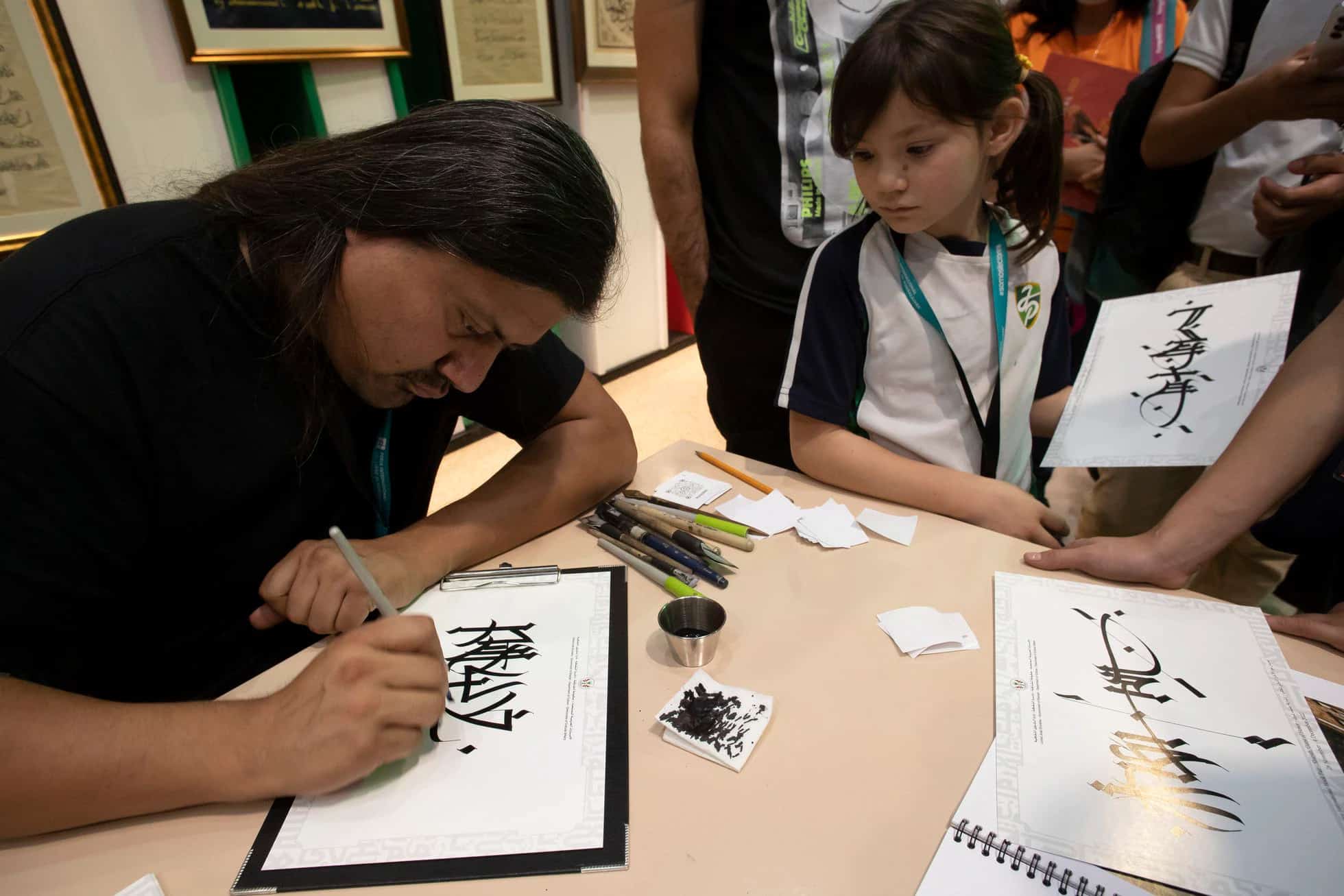


The master calligrapher from Arab Emirates, Khalid Al Jallafis and Mexican artist Said Dokins did live displays of their calligraphic work.
This year, Guadalajara International Book Fair, the most outstanding meeting of the Spanish-language world, invited Sharjah as guest honor, the third largest of the seven Emirates, considered cultural capital of the Arab world by UNESCO.
During nine days, Sharjah Pavilion showcased the Arab culture and literature to Mexico through poetry and literature encounters, editorial industry meetings, as well as a variety of artistic and cultural where writers, editors researchers and artists, spokespersons of Arab culture, built an exceptional quality bridge of Exchange, laying the foundations to update and narrow the relations between Mexico and United Arab Emirates.
Sharjah’s presence in Guadalajara extended to museums, cultural centers, and galleries all over the city. An example was the exhibition organized by the Cultural Department of Culture from Sharjah: “Sharjah. Arqueology, Calligraphy and Ornamentation” at the University Museum of Arts of Guadalajara (MUSA). The show gathers magnificent pieces of art by a selection of artists dedicated to calligraphy from different countries, including United Arab Emirates, Kuwait, Iraq, Algeria, Syria, Egypt, and Iran.

Collaboration between Mexico and Sharjah
The calligraphy exhibition was also shown at the Sharjah Pavilion at Guadalajara Book Fair, where besides the beautiful art works displayed, they counted with the collaboration of two special guests: Khalid Al Jallafis from United Arab Emirates, and Said Dokins from Mexico, who offered live demos to show the public the origins, transitions, and evolution of calligraphy in both countries.
The visitors had also the opportunity to receive from the artists their names written in Arabic or Latin calligraphy, taking them closer to the Arab and Castellan culture and writing. This initiative reflects Sharjah vision to amalgamate the past and present of Arab arts and literature, and its influence in other cultures with the intention to highlight the values of cooperation.

Arab Calligraphy: its history, origin and influences in other cultures

During Guadalajara International Book Fair, the artists gave a couple of conferences about calligraphy. Al Jallafis underlined the languages evolutions, pointing their first expressions in the ancient hieroglyphics, and explaining how, as time passed, through phonetics, the sound were represented by symbols and signs to give birth to the alphabets invented by Sumerians, which gave live to languages as we know them.
Al Jallafis situated the origins of Arab writing in the Egyptian writing system, and stressed its influence too in different countries as China, Greece, and Italy, as well as the participation of not-Arabic artist that have become real Arabic calligraphy masters.

On the other hand, Dokins talked about the Arab culture as a root of an important part of Mexican culture, cryptographies so deep that can be deciphered dissecting gastronomy, language, and artistic expressions throughout the centuries, as an example, he highlighted the more than 4000 Arabisms in Spanish-language, the magnificent Moorish architectonic examples or Mexican majolica.
Dokins gave an overview through the most emblematic works he had developed in a variety of countries, as Germany, Spain, South Africa, Australia, Brazil, Italy, among others, as well as his most recent projects, consisting in light interventions, digital algorithms, and big format installations.

A little more about the artists:
Khalid al Jallafis

Khalid al Jallafis is an artist from United Arab Emirates born in 1962 in Dubai. His first inspiration to learn Arabic calligraphy was the great artist Abdul Qader Al-Rais; later on, the Iraqi calligrapher Nizar Al-Doori, who taught him the 17 basic rules of style and fonts. Khalid takes part of exhibitions in his country and out. His art has been acquired by museums and private colectors in Kuwait, France and the Arab Emirates. In his solo show Letters of Wisdom (Galería Hunar), displays more than twenty new pieces in Qairawani, Nisaboori and modern Cufic styles, as well as pieces that blend calligraphy with Islamic architectural elements.
Said Dokins

Said Dokins began his career as an artist in Mexico City’s graffiti scene during the nineties. Since then, he started to reflect about the ways in which alternative cultural practices relate with public space, mainly, graffiti as an inscription, a transgression, a linguistic gesture and as a politic statement. Dokins interests are centered in creating a new visual understanding of the environment through its textual elements.
Studied Visual Arts at the National School of Plastic Arts (National Autonomous University of Mexico) and did studies on Filosophy (FFyL, UNAM) and Critic Theory at the University Contemporary Art Museum (MUAC-UNAM), in the program Zonas de Disturbio, Campus Expandido.
Among other awards, he received the Iberoamerican Prize to Contemporary Artistic Creation Cortes de Cádiz, Juan Luis Vasallo in Spain, 2015.
Dokins has gained international attention because of his huge dimensions writing mural interventions in public space. His work has been exhibited in Mexico, Spain, Germany, Netherlands, Belgium, United Kingdom, France, Argentine, Chile, Brazil, El Salvador, Peru, among others, outstanding his participation at Urban Art Festival Pow! Wow! in Doha, Qatar (2021), or the International Contemporary Art Biennale OSTRALE, Germany (2017).
His work has been published in books and magazines, in Germany, Mexico, Spain and United States.
His work has been acquired by important collections around the word, as by the Polytechnic University of Valencia, Spain, the International Street Art Museum STRAAT, in Amsterdam, Netherlands, the Museum of Urban and Contemporary Art, in Munich, Germany, and Nuart Street Art Festival, in Stavanger, Norway.
0 Comments
Leave a comment